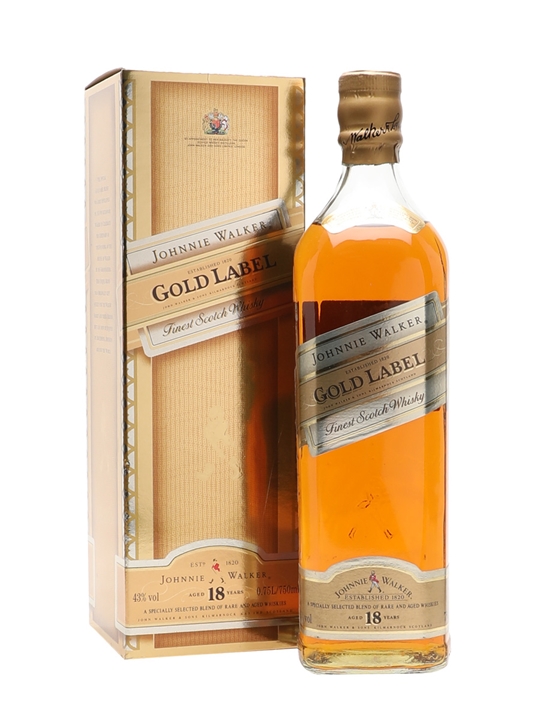

There's something genuinely fascinating about holding a bottle that represents a moment in time — not just for the liquid inside, but for the brand strategy behind it. This 1990s bottling of Johnnie Walker 18 Year Old, marketed under the Gold Label name, is a relic from before Diageo's 2012 portfolio restructure that would eventually reposition Gold Label as the younger, party-friendly Reserve expression. What you have here is the original vision: a serious, age-stated blend built for contemplation, not celebration.
I spent over a decade at Diageo, and I can tell you that the 18 Year Old Gold Label occupied a very specific strategic slot. It sat above Black Label as a step into prestige Scotch, aimed at drinkers who wanted complexity without committing to the price point of Blue Label. At 43% ABV, it was bottled just above the legal minimum, which was standard practice for luxury blends of the era — the assumption being that smoothness, not strength, was what the premium buyer wanted.
The 1990s were an interesting period for Johnnie Walker's blending team. The component malts available then — drawn from Diageo's vast portfolio of distilleries across the Highlands, Speyside, and the Islands — were mature stocks laid down in the late 1970s and early 1980s. That era of cask selection and warehouse management produced a particular house character that's simply not replicable today. Grain whisky production was different too; the column stills were producing spirit with more character than the ultra-clean grain we see in modern blends.
Tasting Notes
I won't fabricate specific notes from memory — the honest truth is that with a bottle this old, condition matters enormously. Fill level, storage conditions, and whether it's been opened all affect what ends up in your glass. What I can say is that 18-year-old blended Scotch from this period typically delivers a richness and depth that modern equivalents struggle to match. Expect a whisky that carries its age gracefully: integrated oak influence, layered sweetness, and a composure that comes from proper maturation rather than flavour engineering.
The Verdict
At £175, you're paying a premium over what this would have cost at retail in the 1990s, obviously. But context matters. The current Johnnie Walker 18 retails around £55-65, and this is a fundamentally different product — different recipe, different era of component whisky, different blending philosophy. For collectors and serious blended Scotch enthusiasts, this is a genuine piece of Johnnie Walker history, and £175 is reasonable for what amounts to a discontinued expression with nearly three decades of additional bottle age behind it.
Is it worth it? If you appreciate blended Scotch as a craft — and not just as a stepping stone to single malts — then absolutely. This is a whisky that reminds you why Johnnie Walker became the world's biggest Scotch brand in the first place. Not through marketing, but through the quality of what was actually in the bottle. I'm giving it 8.5 out of 10, weighted by both its historical significance and the calibre of liquid you're likely to find inside.
Best Served
Neat, in a Glencairn or a tulip glass, at room temperature. Give it ten minutes after pouring — a whisky this old deserves the chance to open up. If you're feeling sacrilegious, a few drops of water won't hurt it, but ice would be a waste. This is a whisky for a quiet evening with good company and no distractions. Pour it after dinner, not before.