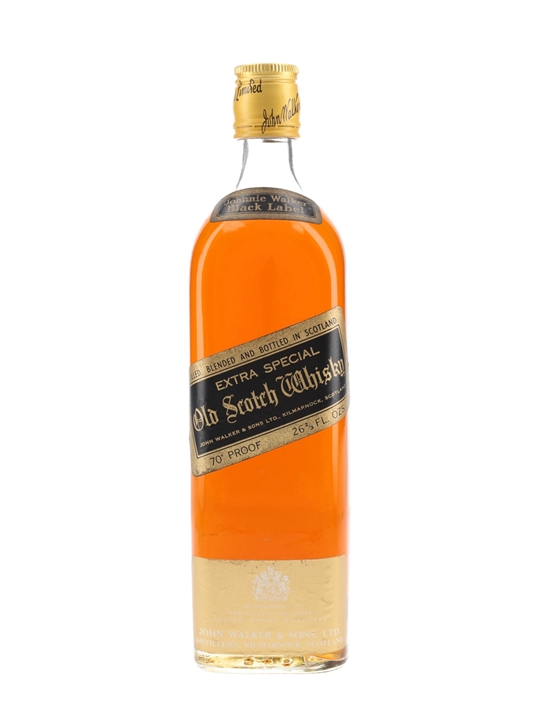

There's something almost archaeological about opening a bottle of Johnnie Walker Black Label from the 1970s. This isn't the Black Label you pick up at duty free — this is a snapshot of blended Scotch from an era when the component malts were drawn from a very different pool of stock, when distilleries that have since closed were still filling casks, and when the house style at Diageo's predecessors was shaped by an entirely different set of commercial pressures. At £225, you're not paying for a standard blend. You're paying for a time capsule.
What to Expect
I should be upfront: specific tasting notes for a bottle of this age and provenance are tricky to generalise, because storage conditions over five decades matter enormously. What I can say is that 1970s-era Black Label was built on a foundation of Cardhu, Talisker, and a rotation of Speyside and Highland malts that no longer exist in the same form. The grain component would have been heavier and richer than modern equivalents, distilled at a time when efficiency hadn't yet stripped character from the column stills. If the bottle has been stored well — upright, cool, out of direct light — you should find a whisky that's noticeably rounder and more full-bodied than its contemporary descendant. The 40% ABV was standard then as now, but the texture these older blends carry often punches above that modest strength.
The "Extra Special" designation on the label is a period detail rather than a quality tier — it was the standard descriptor for Black Label in export markets during this era. Don't read too much into it, but do appreciate the label design. Johnnie Walker packaging from the seventies has a certain honest utilitarianism that I find rather appealing compared to today's holographic, focus-grouped efforts.
The Verdict
Rating this at 8.1 out of 10 reflects genuine quality with a necessary caveat. If you find a well-stored bottle, this is a fascinating and genuinely rewarding dram — a window into how blended Scotch tasted before the closures of the 1980s and the lighter, more approachable direction the category has taken since. The depth of flavour in old blends consistently surprises people who've written off the category based on modern supermarket expressions. However, at £225, you're firmly in collector territory. This isn't a bottle you buy for casual drinking. It's one you buy because you're curious about Scotch history, because you want to taste the difference that half a century makes, or because you're the sort of person who finds romance in old things. I happen to be all three, which is why my bottle is half empty.
The value proposition here is actually reasonable by vintage spirits standards. Try finding a single malt from the 1970s for £225 — you won't. The blended category gives you access to old liquid at prices that haven't yet been inflated by the auction-house frenzy that's gripped aged single malts. That window is closing, mind you.
Best Served
Neat, at room temperature, in a proper tulip glass. Give it ten minutes after pouring — old whisky at 40% needs air to open up. If you're feeling brave, a few drops of water can unlock additional complexity, but start without. This is a whisky you sit with. No ice, no mixers, no rush. Put the phone down. You've waited fifty years for this pour, even if you didn't know it.