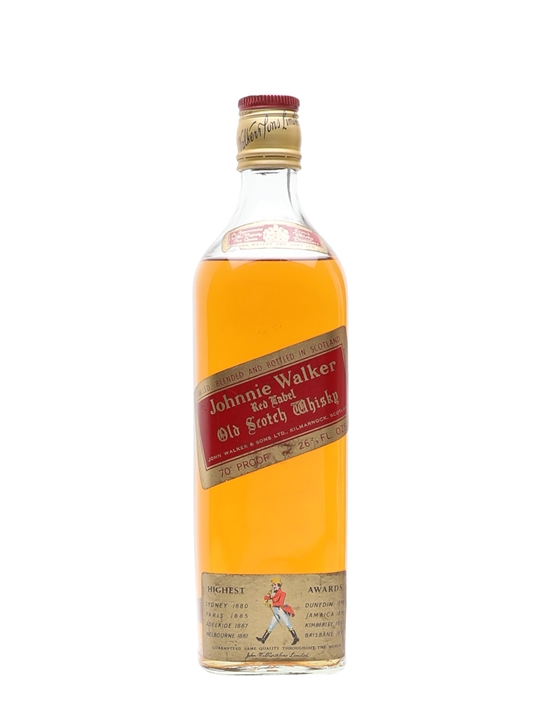

There's something quietly thrilling about holding a bottle of Johnnie Walker Red Label from the 1970s. Not because it's rare in the traditional sense — Red Label has always been the workhorse of the Walker stable, the blend that kept the lights on at Kilmarnock and funded every prestige release that followed. But a bottle from this era represents a fundamentally different product to what sits on supermarket shelves today. The blending landscape, the component malts available, the sheer volume of aged stock swimming around Scotland in that decade — all of it fed into a Red Label that bore the same name but told a very different story.
I've spent enough years on the corporate side of Scotch to know that blended whisky economics have shifted dramatically since the 1970s. Back then, blenders had access to deeper pools of mature stock. The grain whisky component was produced under different conditions, and the malt contributions — drawn from a portfolio that included some genuinely distinguished distilleries — were often more generous than modern cost structures would permit. This isn't nostalgia talking. It's arithmetic.
At 40% ABV and without an age statement, this follows the standard Red Label template. But the context matters enormously. A NAS blend from the early 1970s was operating under different norms. The base expectation for quality in everyday Scotch was, by many accounts, simply higher. Whether that holds up in the glass after fifty-odd years in bottle is the real question, and condition will vary enormously depending on storage. A well-kept bottle with a good fill level and intact seal has every chance of delivering something genuinely interesting.
Tasting Notes
I won't fabricate specific notes here — vintage bottles are inherently unpredictable, and the interplay between original spirit character and decades of slow evolution under glass makes each bottle its own small experiment. What I will say is that 1970s Red Label is widely regarded among vintage blend collectors as a benchmark for what mass-market Scotch once was. Expect a rounder, more malt-forward profile than its modern descendant, with a complexity that reflects the era's blending philosophy.
The Verdict
At £150, this sits in fascinating territory. You're paying a premium over what Red Label costs today, obviously, but you're not buying today's Red Label. You're buying a window into a different era of Scotch production, bottled by one of the most significant names in the industry's history. For collectors, it's a solid addition — Walker bottles from this period are well-documented and widely recognised. For drinkers, it's a genuine education in how blended Scotch has evolved over half a century. I'd rate this 8.2 out of 10. It loses nothing for being a blend — if anything, this is a reminder that blending at its best is one of Scotch whisky's great arts. The price is fair for what amounts to a piece of liquid history from a brand that quite literally shaped the global whisky market.
Best Served
If the seal is good and the fill level healthy, pour this neat at room temperature in a Glencairn or a tulip glass. Give it ten minutes to open up — spirit of this age deserves patience. A few drops of water won't hurt if it feels tight, but start without. This isn't a cocktail ingredient. It's a conversation piece that happens to be drinkable, and potentially a very good one at that. Save it for an evening when you can actually pay attention to what's in the glass.