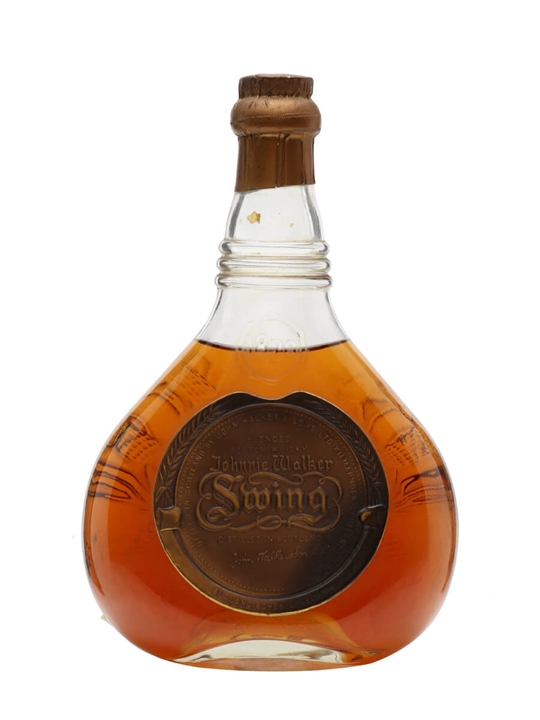

There's something quietly theatrical about Johnnie Walker Swing. The rocking bottle, designed so it wouldn't topple on ocean liners, has always felt like a statement piece — a blend that wanted you to know it wasn't just another blended Scotch. This particular bottling, dating from the 1960s, takes that proposition and adds several decades of mystique. At £399, you're not just buying whisky. You're buying a time capsule from an era when blended Scotch ruled the world and nobody had to apologise for it.
Swing was created in 1932, positioned as Johnnie Walker's prestige blend for the transatlantic set. By the 1960s, Diageo's predecessor — then DCL — had access to an extraordinary portfolio of distilleries, and the component malts available to the blenders of that period were, frankly, from a different universe to what goes into most modern blends. The grain whisky, too, would have been produced under different conditions, different yeast strains, different still configurations. What you're holding is a snapshot of Scottish whisky production at a particular moment, and that alone makes it worth serious attention.
At 43% ABV, this sits at the standard strength for premium blends of the era — no chill-filtration controversy, no arguments about bottling proof. It is what it is: a product of its time, bottled with confidence. The NAS designation is irrelevant here. Nobody was chasing age statements in the 1960s. The blenders were chasing flavour, and they had the stock to do it.
What to Expect
Without opening this bottle — and I'd understand if you chose not to — you're looking at a blend from the golden age of Scotch whisky production. 1960s blends are consistently praised by collectors and whisky historians for their depth and complexity. The grain component tends to show more character than its modern equivalent, and the malt content in a prestige blend like Swing would have been generous. Expect a richer, more textured experience than anything carrying the Swing name today. The style leans towards honeyed warmth with a confident backbone — this was whisky built for first-class cabins and boardroom drinks trolleys, and it carries that weight.
The Verdict
I'll be honest: £399 for a blended Scotch makes the spreadsheet part of my brain twitch. But context matters. This isn't a modern blend with a vintage label slapped on it. This is genuine 1960s liquid, stored for over sixty years, from a period when the raw materials and blending philosophy were fundamentally different. Comparable vintage Johnnie Walker bottlings have been climbing in value steadily, and Swing — with its distinctive bottle and loyal following — tends to hold its own at auction. As a drinking experience, assuming good storage, this should deliver something genuinely distinct from anything on the current market. As a collector's piece, it's fairly priced against recent auction results. I'm giving it 8.1 — a strong score that reflects both the historical significance and the likely quality of the liquid inside. It loses a fraction because, at this price point, the lack of confirmed provenance and storage history introduces a small element of risk that you simply don't face with a freshly bottled single malt.
Best Served
If you open it, treat it with respect but don't overthink it. A small pour — 25ml at most — in a good tulip glass, neat, at room temperature. Give it ten minutes to breathe after pouring. The old blends tend to open up slowly and reward patience. No ice, no water on the first pour. If you find it's robust enough after the initial tasting, a few drops of water might coax out additional nuance, but start clean. This is whisky that was made to be drunk, not worshipped — but it deserves your full attention when you do.