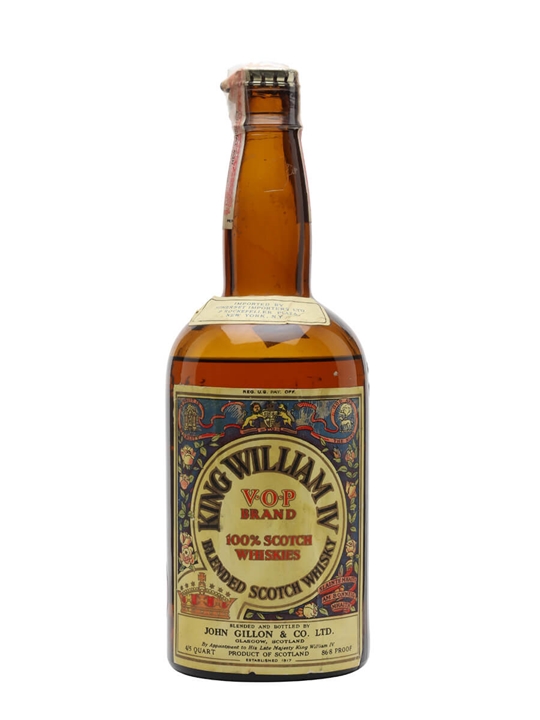

There's something quietly thrilling about holding a bottle that's older than most of the whisky industry's current marketing playbook. The King William IV VOP, bottled sometime in the 1950s, is a blended Scotch from an era when the category wasn't fighting for shelf space against craft bourbon and Japanese single malts — it simply was the default spirit of the civilised world. At 43% ABV and carrying the 'VOP' designation (Very Old Particular, a quality marker that's largely fallen out of use), this is a window into mid-century blending at its most confident.
Let's be honest about what you're buying here. At £375, this isn't a casual purchase. You're paying for provenance, for history, for a liquid time capsule. The blending houses of the 1950s were working with malt and grain whiskies produced in the 1940s and earlier — a period when production methods, barley strains, and even the peat itself were meaningfully different from what we know today. Floor maltings were standard, not a heritage marketing exercise. Worm tub condensers were the norm. The grain component would have come from a smaller pool of operational grain distilleries, each with more character than their modern equivalents.
The King William IV brand itself sits in that fascinating category of historical Scotch labels that once commanded genuine retail presence but have since faded from the mainstream. These bottles surface through auction houses and specialist retailers, and they tend to move quickly among collectors and serious drinkers who understand that old blended Scotch often outperforms its reputation. The snobbery that single malt enthusiasts direct at blends falls apart entirely when you're dealing with liquid from this period. The component whiskies were simply built differently.
Tasting Notes
I won't fabricate specific tasting notes here — with a bottle of this age and scarcity, conditions matter enormously. Fill level, storage history, and the integrity of the cork all play their part. What I can say is that 1950s blended Scotch at 43% typically delivers a richness and waxy complexity that modern blends at similar strength rarely approach. Expect a whisky that feels substantial, with the kind of integrated character that only decades of bottle maturation can produce. The grain and malt components will have married completely by now, creating something genuinely unified rather than a mere assemblage of parts.
The Verdict
I'm giving the King William IV VOP a 7.8 out of 10. That's a strong score, and it reflects genuine quality — but it also acknowledges that at £375, you need to know what you're getting into. This isn't the whisky to convert someone who doesn't already appreciate aged spirits. For collectors and serious Scotch drinkers, however, it's a compelling proposition. You're not just buying a dram; you're buying a direct comparison point against everything the industry has become since. The fact that it's a blend makes it more interesting, not less. This is what blended Scotch was supposed to be before the accountants got involved.
Best Served
Neat, at room temperature, in a tulip glass. Give it a good fifteen minutes of air after pouring — spirits this old can be initially reticent before they open up properly. A few drops of water won't hurt if the proof feels assertive, but start without. This is an after-dinner whisky, best enjoyed slowly with no distractions and perhaps one trusted friend who'll appreciate what's in the glass. Save the soda water for something that costs less than your electricity bill.