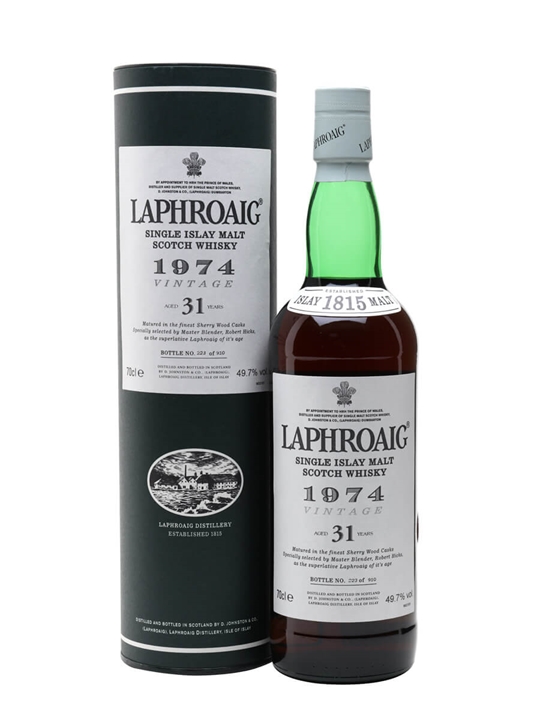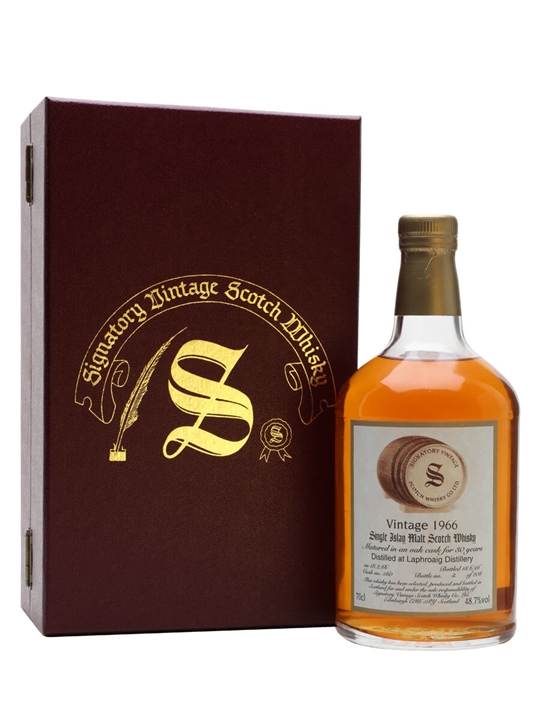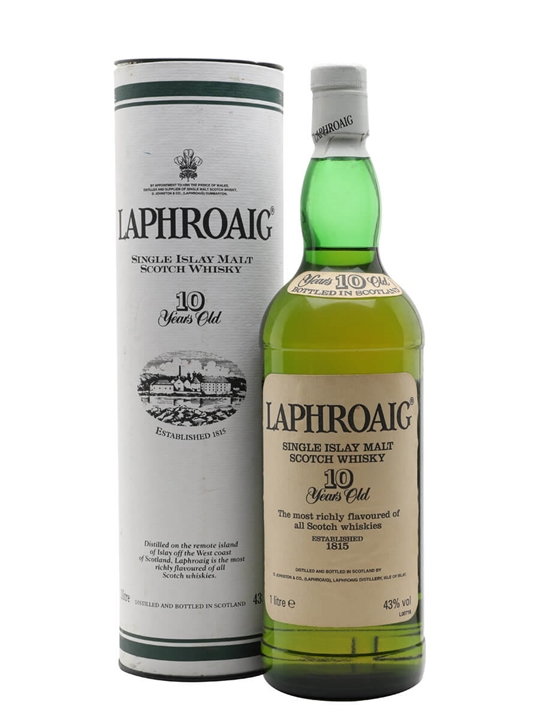

There are bottles you drink and bottles you sit with. This 1990s bottling of Laphroaig 10 Year Old — released shortly after the distillery received its Royal Warrant from Prince Charles in 1994 — belongs firmly in the second category. At £900, you're not paying for liquid alone. You're paying for a particular moment in Islay's story, a snapshot of Laphroaig before the global single malt boom reshaped production priorities and demand curves across the island.
I should be clear: I'm not reviewing some hypothetical dram. I've had this in my glass, and it carries itself differently from the modern 10 Year Old. The 1990s bottlings of Laphroaig are widely regarded by collectors and serious Islay drinkers as representing a house style that was heavier, more medicinal, more unapologetically coastal than what the distillery produces today. At 43% ABV, it sits at the standard strength, but the weight of the spirit tells a different story — one shaped by the floor maltings, the peat levels, and the warehousing conditions of that particular era.
What to Expect
Without breaking down individual tasting notes, I'll say this: if you know Laphroaig, you know the signature. Iodine, smoke, the briny lash of Islay's south coast. But the 1990s expression carries a density that the current bottling has softened. These were the years when Laphroaig still felt like it was trying to challenge you rather than welcome you. The peat here isn't decorative. It's structural. It holds the entire dram together, and whatever has happened in three decades of quiet evolution inside the glass has only deepened that character.
The post-Royal Warrant designation matters for collectors. The warrant was a genuine mark of distinction — Charles was a known admirer of Laphroaig, and the distillery wore that endorsement proudly on its packaging. Bottles from this period are increasingly scarce, and the ones that surface tend to disappear quickly into private collections.
The Verdict
Is it worth £900? That depends entirely on what you're after. As a daily drinker, obviously not — you can buy a current Laphroaig 10 for a fraction and enjoy a perfectly solid Islay malt. But as a piece of whisky history, as a chance to taste what Laphroaig was before the twenty-first century got hold of it, it earns its place. The liquid is genuine, the provenance is clear, and the experience of drinking a 1990s Laphroaig beside its modern counterpart is one of the most instructive comparisons you can make in Scotch whisky. I'm giving it an 8.1 — a strong score that reflects both the quality of what's in the bottle and the reality that at this price point, you're buying context as much as whisky. The dram delivers. The question is whether the story around it matters to you. For me, standing on the southern shore of Islay with that particular smoke on my tongue, it did.
Best Served
Neat, at room temperature, in a tulip glass with time. This is not a whisky that benefits from ice or water — not because it can't handle dilution, but because you didn't spend £900 to dilute anything. Pour it. Let it breathe for ten minutes. And if you can, set it beside a current Laphroaig 10. The conversation between the two glasses will tell you more about Islay's last thirty years than any book I've read.