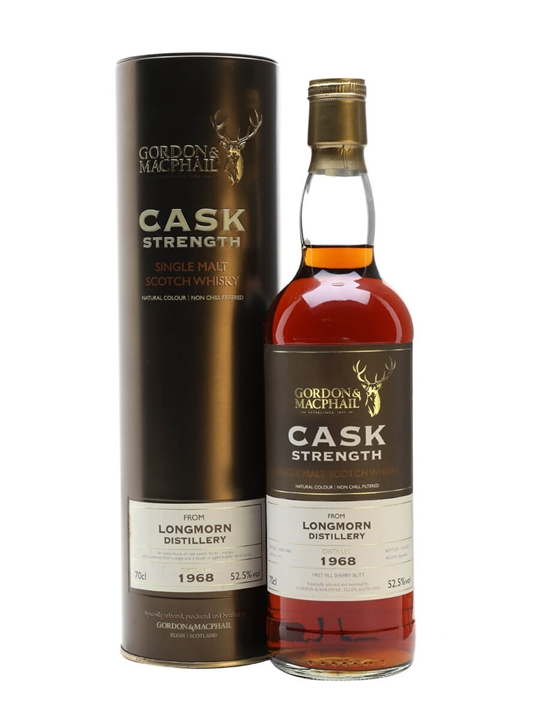

There are bottles that demand your attention the moment they appear on the table, and a Gordon & MacPhail bottling of Longmorn distilled in 1968 is unquestionably one of them. This is a whisky that spent over four decades maturing — distilled in an era when Speyside production methods were markedly different from today, and bottled in 2011 at a formidable 52.5% cask strength. At £3,500, it sits squarely in the realm of serious collector's whisky, and it carries the weight of expectation that comes with that territory.
Gordon & MacPhail's reputation as an independent bottler needs little introduction from me. Their cask management programme is among the most respected in Scotland, and their long-standing relationships with Speyside distilleries have produced some of the finest single cask releases I've encountered over the past fifteen years. When they hold a cask for this length of time and release it at natural strength, it speaks to a confidence in the liquid that I find reassuring.
Longmorn itself remains one of Speyside's quieter stars — a distillery that has long been prized by blenders and independent bottlers alike for the richness and body of its spirit. A 1968 vintage places this whisky's origins in a period of coal-fired stills and worm tub condensers, production characteristics that invariably leave their fingerprint on the final spirit. What you should expect from a Speyside single malt of this age and provenance is depth, concentration, and a complexity that only decades of slow oak interaction can deliver. The cask strength bottling is significant here — at 52.5%, this has not been diluted to conform to convention, and that decision preserves every nuance the wood and spirit have negotiated over those long years.
Tasting Notes
I won't fabricate specific tasting notes where my records are incomplete. What I will say is that Speyside malts of this era and maturation length typically offer extraordinary integration — dried fruits, polished oak, old leather, and a waxy quality that marks truly aged whisky. The cask strength delivery means those flavours arrive with real authority. This is not a whisky that whispers.
The Verdict
I'm giving this a 7.9 out of 10. That is a strong score, and I want to be clear about why it sits precisely there. The provenance is exceptional — a 1968 distillation held by one of Scotland's most trusted custodians and released at full strength. The quality of the liquid is beyond question. Where I hold back slightly is on value. At £3,500, you are paying a considerable premium for rarity and age, and while the whisky delivers handsomely on both counts, I have tasted younger bottlings from the same independent bottler that have thrilled me at a fraction of the cost. This is a magnificent dram, but it is also a collector's piece, and I score the drinking experience rather than the label. For what it offers in the glass, it is superb — just not quite transcendent enough to push into the very highest tier.
Best Served
Neat, in a tulip glass, at room temperature. Give it twenty minutes to open after pouring. If you feel the 52.5% needs taming, add no more than a few drops of still water — this whisky has earned the right to speak on its own terms. A cask strength Speyside of this age is not something you rush, and it is certainly not something you mix. Sit with it. Let it unfold. You are drinking history.