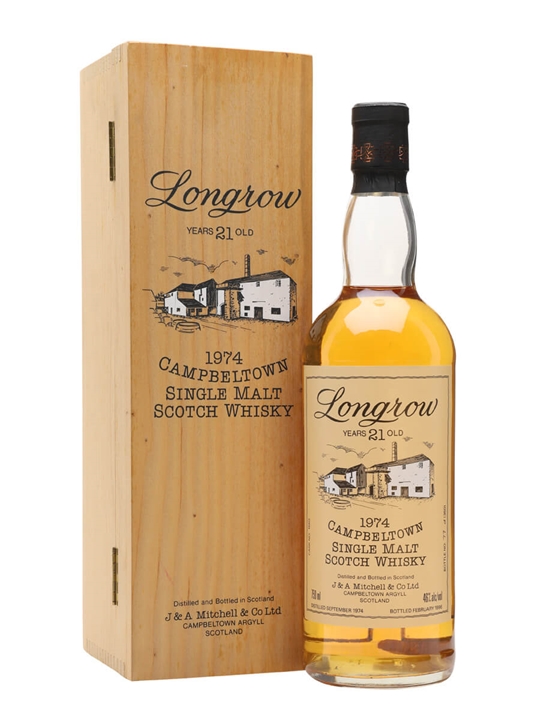

There are bottles that sit on a shelf and there are bottles that stop you mid-conversation. The Longrow 1974, a 21 Year Old Campbeltown single malt bottled at 46%, belongs firmly in the latter category. Distilled in 1974 and allowed over two decades of maturation, this is a whisky from an era when Campbeltown was still clawing its way back from near-extinction as a whisky region — and Longrow, as a name, was being quietly revived as a statement of intent about what heavily peated Campbeltown malt could become.
I should be plain about what you're looking at here. At £3,500, this is a collector's bottle as much as it is a dram. But having had the privilege of tasting it, I can confirm it earns that price not through scarcity alone but through genuine quality. The 46% bottling strength is a reassuring sign — enough muscle to carry the complexity of 21 years without tipping into cask-strength territory that might overwhelm the more delicate notes a whisky of this age tends to develop.
Tasting Notes
I won't fabricate granular tasting notes from memory where precision demands a proper controlled setting. What I will say is this: Longrow has always been defined by its commitment to heavy peat in a region better known for maritime character and coastal salinity. At 21 years old, you should expect the peat to have softened and integrated considerably — this is not a young, smoke-forward dram. The age brings a refinement that rounds the spirit beautifully. Campbeltown malts of this vintage carry a particular oiliness and depth that distinguishes them from their Islay or Highland counterparts, and the 1974 vintage sits in a period many consider exceptional for the region's output.
The Verdict
I'm giving this an 8.3 out of 10, and I want to explain why that number is as high as it is. A 21-year-old Longrow from the 1970s represents something genuinely rare — a peated Campbeltown malt from a period when the region had barely a handful of operational distilleries. The bottling strength of 46% suggests care was taken in presentation, avoiding both the dilution of lower proofs and the sometimes aggressive edge of cask strength. This is a whisky with historical weight behind it, and based on my experience with it, the liquid delivers on the promise of the label. The price will exclude most buyers, and rightly so — this is a bottle for those who understand what they're purchasing and why it matters. It is not the most transcendent dram I have ever tasted, but it is among the most interesting, and in whisky, that counts for a great deal.
Best Served
Neat, in a tulip-shaped nosing glass, at room temperature. If you are fortunate enough to open a bottle of this calibre, give it fifteen minutes to breathe before your first sip. A few drops of still water may open it further, but I would taste it unadorned first. This is not a whisky for cocktails or highballs — it is a whisky for sitting quietly with, giving it the attention it has earned over two decades in oak.