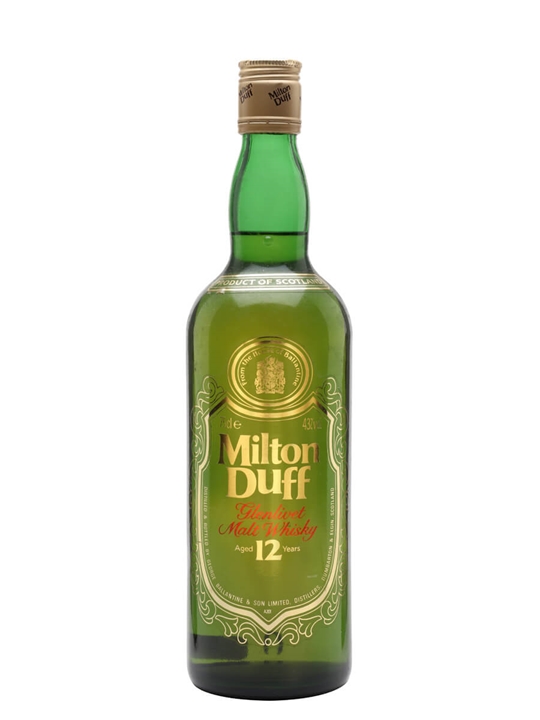

There are distilleries that command headlines, and there are those that quietly define the character of an entire region. Miltonduff has always belonged to the latter camp. Tucked into the heart of Speyside, it has spent the better part of two centuries producing malt that underpins some of the world's most recognisable blends — Ballantine's chief among them. To encounter a 12 Year Old official bottling from the 1980s is to hold a small piece of Scotch whisky's working history in your hands, and at £199, it asks you to decide what that history is worth to you.
I'll tell you plainly: it's worth it.
What to Expect
This is a Speyside single malt bottled at 43% ABV during a period when distillery bottlings from lesser-known producers were genuinely uncommon. Through the 1980s, most of Miltonduff's output disappeared into blending vats, which makes any official single malt release from this era something of a quiet anomaly. The 12-year age statement places it squarely in that sweet spot where oak influence has had time to do meaningful work without overwhelming what is, by reputation, a clean and gently fruity spirit.
Miltonduff's house style has long been associated with a certain grassy freshness layered over orchard fruit — a character that lends itself beautifully to blending but stands perfectly well on its own. At 43%, this bottling carries just enough weight to suggest the distillery was serious about presenting its spirit as a credible single malt, not merely a curiosity. That extra degree above the standard 40% may sound marginal, but in practice it tends to preserve texture and complexity that would otherwise flatten out.
The 1980s bottling era is significant for another reason. Production methods at many Speyside distilleries were still deeply rooted in tradition during this period, with direct-fired stills and worm tub condensers more common than they are today. Whether Miltonduff employed these specific methods at the time of this spirit's distillation in the early 1970s, I cannot confirm with certainty, but the broader context matters: whisky from this era often carries a weight and character that modern efficiencies have, in some cases, streamlined away.
The Verdict
I rate this Miltonduff 12 Year Old an 8.4 out of 10. It earns that score not through flash or theatrics, but through quiet conviction. This is a bottle for the collector who understands that Speyside is not defined solely by Macallan and Glenfiddich — that the region's true depth is found in distilleries like Miltonduff, which have spent generations doing exceptional work with minimal fanfare. At £199, you are paying for provenance, for scarcity, and for a style of Scotch that simply isn't produced in quite the same way anymore. For the serious whisky drinker building a collection with real range, this fills a gap that few other bottles can.
It is, in the truest sense, a drinker's bottle — one that rewards patience and attention rather than demanding it.
Best Served
Neat, at room temperature, in a tulip-shaped nosing glass. If you've waited decades to open a bottle like this, give it the respect of ten minutes in the glass before your first sip. A few drops of still water may open things up further, but I'd suggest tasting it unadorned first. This is not a whisky for cocktails or ice. Let it speak.