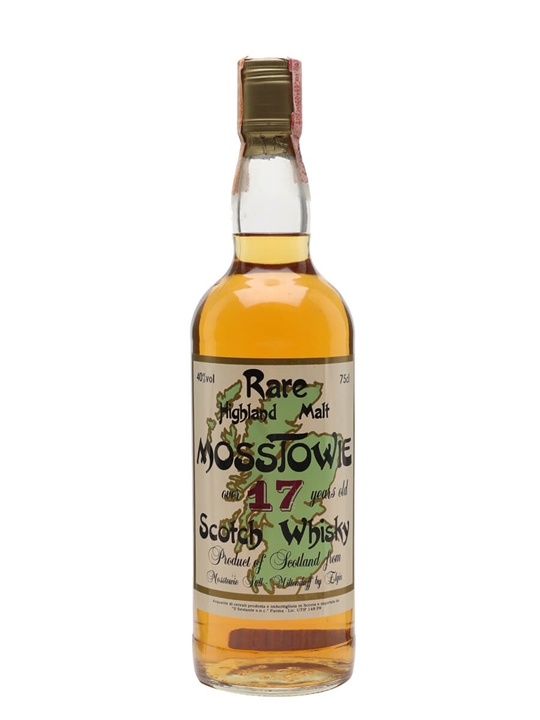

There are bottles that sit on the periphery of Scotch whisky history — not because they lack quality, but because the distilleries that produced them were never meant to last forever. Mosstowie is one such name. A Lomond still operation housed within the walls of Miltonduff distillery in Speyside, Mosstowie produced spirit for a relatively brief window before the stills were removed in 1981. What we have here, then, is a 17-year-old single malt bottled in the 1980s by the Italian independent bottler Sestante — a firm that, during its heyday, laid down some remarkably well-chosen casks from across Scotland.
I should be clear: Mosstowie is not a distillery you will find on any map today. It existed as a parallel production line within Miltonduff, using Lomond stills — those curious, column-like pot stills with adjustable plates designed to produce a heavier, more characterful spirit than the standard output. The result was always distinct from Miltonduff's own make, and that distinction is precisely what makes surviving bottles so sought after among collectors and serious drinkers alike.
At 40% ABV, this has been bottled at the standard strength typical of the era. Some will lament that it wasn't offered at cask strength, and I understand the sentiment — but context matters. In the 1980s, Sestante was bottling for a market that valued elegance and drinkability, and seventeen years in oak at this strength would have allowed the spirit to settle into something composed and approachable.
Tasting Notes
I won't fabricate specific tasting notes where my memory cannot do them proper justice at this remove. What I will say is this: Lomond still spirit from Speyside, aged for seventeen years and bottled by a house with Sestante's reputation for cask selection, sits in a category that rewards patience. Expect a spirit that carries the weight of its unusual production method — broader and oilier than a typical Speyside of the same era, with the kind of textural depth that Lomond stills were engineered to deliver. This is a whisky that tells you something about how it was made the moment it hits the glass.
The Verdict
At £600, this is unambiguously a collector's bottle, and the price reflects the reality of a closed distillery with extremely limited surviving stock. But I want to be direct: this is not merely a curio. Mosstowie at seventeen years represents a genuine piece of Scotch whisky's experimental period — a time when the industry was willing to install unusual equipment and see what happened. The fact that Sestante saw fit to bottle it as a single malt, rather than letting it disappear into a blend, tells you something about the quality of what was in that cask. I rate this an 8 out of 10. It earns that score not on nostalgia alone, but on the strength of its provenance, its scarcity, and the legitimate quality that Lomond still Speyside spirit can achieve with nearly two decades of maturation. For the collector who values whisky history as much as liquid quality, this is a bottle worth owning.
Best Served
Neat, and at room temperature. If you are fortunate enough to open one, give it twenty minutes in the glass before you begin — spirit of this age and rarity deserves the time to open up fully. A few drops of soft water if you wish, but nothing more. This is not a whisky for cocktails or casual mixing. It is a piece of history, and it should be treated as such.