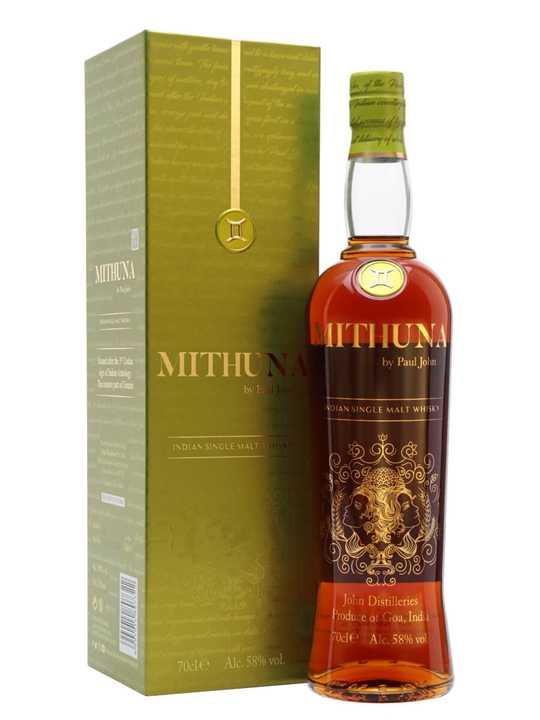

There was a time, not so long ago, when the phrase "Indian single malt" would have drawn a raised eyebrow at any serious tasting table. That time has passed. Paul John Mithuna has been one of the bottles quietly responsible for shifting that conversation, and having spent considerable time with this expression, I can tell you the reputation is well earned.
Mithuna — the name drawn from the Gemini zodiac sign — is a cask strength single malt bottled at a commanding 58% ABV. This is not a whisky that asks for your attention politely. It demands it. Paul John has built its range on the back of Goa's tropical climate, where the angel's share is aggressive and maturation is accelerated in ways that Scottish warehouses simply cannot replicate. The result, at its best, is intensity and concentration that belies the lack of an age statement.
What makes this particular expression interesting is the approach to cask selection. The Mithuna release has historically drawn from a combination of ex-bourbon and ex-Oloroso sherry casks, and the interplay between those two wood types is central to its character. At 58%, you are getting the whisky as close to straight from the cask as makes no difference — unfiltered, uncompromised, and unapologetically full-bodied. For a single malt at this strength, the asking price of £232 positions it firmly in premium territory, but it is competing with established names and, frankly, holding its ground.
What to Expect
Without tasting notes to hand for this specific batch, I will say this: Paul John Mithuna is a whisky that trades on richness and weight. The cask strength bottling means you should expect a full-throated arrival — this is not a delicate dram. The tropical maturation typically pushes these malts toward deeper fruit character and a density of flavour that you might associate with sherried Scotch at twice the age. There is a muscularity here that I find genuinely appealing. It does not try to be something it is not. It is an Indian single malt, made in the heat of Goa, and it wears that identity with confidence.
The NAS designation will put off some buyers, and I understand the instinct. But age statements tell you how long the whisky sat in wood — they do not tell you what happened while it was there. In a climate like Goa's, three years of maturation can accomplish what twelve might in the Scottish Highlands. Judge the liquid, not the label.
The Verdict
I am giving Paul John Mithuna an 8 out of 10, and I do so without hesitation. This is a serious, well-constructed single malt that rewards patience and a willingness to look beyond traditional whisky-producing nations. At £232, it is not an impulse purchase, but it delivers complexity and power that justify the outlay. If you have been curious about what the best Indian distillers are capable of, this is one of the bottles that will answer that question definitively. It has earned its place on the shelf alongside single malts from anywhere in the world.
Best Served
Pour this neat and give it ten minutes to open up in the glass — at 58%, it needs the breathing room. Once it has settled, add a few drops of water. Not a splash, just enough to take the edge off the alcohol and let the underlying character come forward. A cask strength whisky like this reveals itself in stages, and rushing it would be doing yourself a disservice. A Glencairn glass is ideal. This is an evening dram — give it the time it deserves.