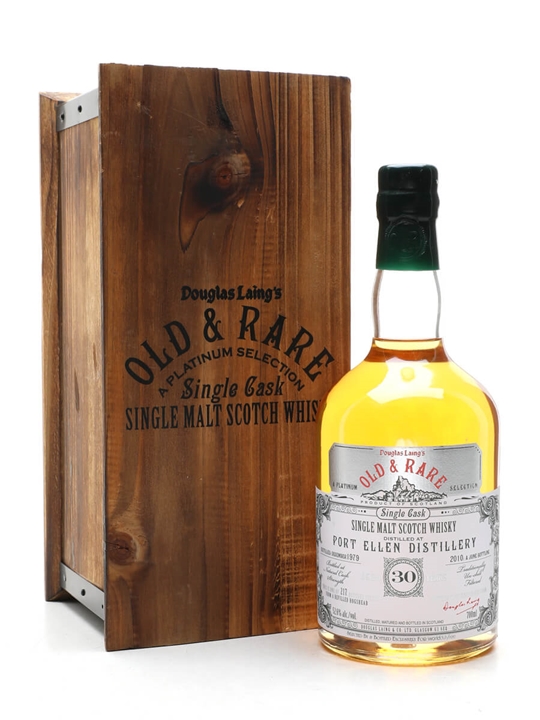

There are bottles you drink and bottles you sit with. Port Ellen 1979, bottled at 30 years old by Douglas Laing for their Old & Rare Platinum series, is emphatically the latter. I opened mine on a night when the rain was doing that sideways thing it does on the Scottish west coast, and I can tell you — the timing felt ordained.
Port Ellen closed its doors in 1983. That fact alone gives every surviving cask a weight that transcends the liquid inside. But let's not get sentimental. This is Islay whisky, and Islay whisky demands you pay attention to what's in the glass, not what's in the history books. At 52.6% ABV and three decades in oak, this is a spirit that has had a very long conversation with wood and emerged with something to say.
What defines Port Ellen — what has always defined it — is that particular marriage of coastal peat smoke and an almost medicinal precision. This isn't the bonfire-and-barbecue peat of some younger Islays. Thirty years have done what thirty years do: they've smoothed the edges without erasing the character. The distillery sat right on the shore at the south of Islay, and if you've ever stood on that stretch of coastline and breathed in, you already know something about what ended up in these casks.
The Old & Rare Platinum bottlings from Douglas Laing are single cask, natural colour, non-chill-filtered — the full purist's charter. At cask strength, this is whisky that rewards patience. A few drops of water don't diminish it; they open a door.
Tasting Notes
I'll be honest with you: I'm not going to fabricate a twelve-point flavour wheel here. What I will say is that a 30-year-old Port Ellen at cask strength occupies a space that very few whiskies can reach — the intersection of power and refinement, smoke and sweetness, the sea and the cask. Expect the signature Islay coastal character tempered by decades of maturation. This is old peat, dignified peat, the kind that whispers rather than shouts.
The Verdict
At £1,750, this is not an impulse buy. But context matters. Port Ellen casks are finite and dwindling. Every year there are fewer, and every year the ones that remain get older, stranger, and more expensive. Compared to what some auction houses are fetching for similar vintages, this is — remarkably — not unreasonable.
What earns this bottle an 8.4 is the combination of provenance, quality, and sheer presence. This is a whisky from a distillery that no longer exists, bottled by people who understand how to let a cask speak for itself. It's not perfect — perfection at this age and price point would require something almost supernatural — but it is genuinely special. It carries the ghost of a place and a time, and it does so at a strength and integrity that honours both.
If you're a collector, you already know what this is. If you're a drinker, the only question is whether you're willing to spend what it costs to taste a piece of Islay's past. I was, and I don't regret it.
Best Served
Neat, in a Glencairn, with nothing more than a few drops of cool water if the cask strength feels like too much. Give it twenty minutes in the glass before you start — this whisky has waited thirty years, it can handle twenty more minutes. A quiet room. No distractions. Maybe some rain on the window if you can arrange it.