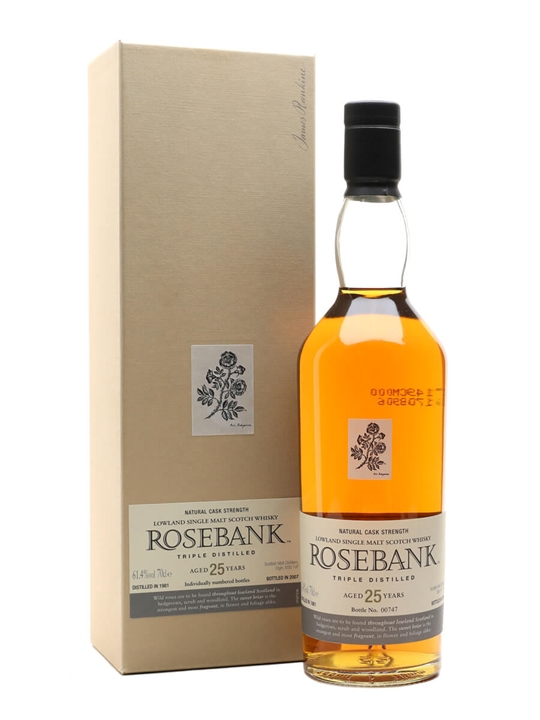

There are bottles that arrive on your desk and demand a moment of stillness before you even think about pulling the cork. The Rosebank 1981, a 25 Year Old Lowland Single Malt bottled at a commanding 61.4% ABV, is precisely that kind of whisky. Rosebank is a name that carries enormous weight among serious collectors and drinkers alike — a Lowland distillery whose output has become increasingly scarce and fiercely sought after. To hold a quarter-century-old expression from the 1981 vintage is to hold something that simply cannot be replicated.
At £2,500, this is not a casual purchase. But let me be direct: for what it represents, it is not unreasonable. Lowland single malts of this age and provenance are vanishing from the market, and each year the remaining stock dwindles further. This is a whisky for someone who understands what scarcity actually means — not as a marketing term, but as a material fact.
What to Expect
The Lowland style has always occupied a distinct position in Scotch whisky. Where the Highlands and Islay trade in drama, the Lowlands have historically offered something more considered — lighter in body, often floral, with a gracefulness that rewards patience. At 25 years old, you would expect considerable oak influence, but the cask strength bottling at 61.4% suggests this was drawn from wood that had something left to give. There is no chill filtration masking the texture here; this is whisky presented honestly, without apology.
I would strongly recommend approaching this one with time and an open glass. At full strength, the ABV will assert itself, but a few drops of water should unlock the kind of complexity that a quarter century in oak can deliver. Do not rush it. A whisky like this has waited 25 years — you can spare it twenty minutes.
The Verdict
I have given the Rosebank 1981 a score of 8.7 out of 10. That reflects both the quality of what is in the glass and the significance of the bottle itself. Rosebank at this age is a rare intersection of historical importance and genuine drinking pleasure. It is not a museum piece to be admired from a distance; it is a whisky that justifies its reputation through substance. The cask strength presentation shows confidence from whoever selected this cask — they knew what they had and chose not to dilute it, literally or figuratively. For collectors, this is an anchor bottle. For drinkers, it is a privilege.
Best Served
Neat, in a tulip-shaped nosing glass, with still water on the side. Add water sparingly — a few drops at a time — and let the whisky open at its own pace. At 61.4%, it will reward your patience. Room temperature, no ice. This is not a whisky that needs anything added to it; it needs only your attention.