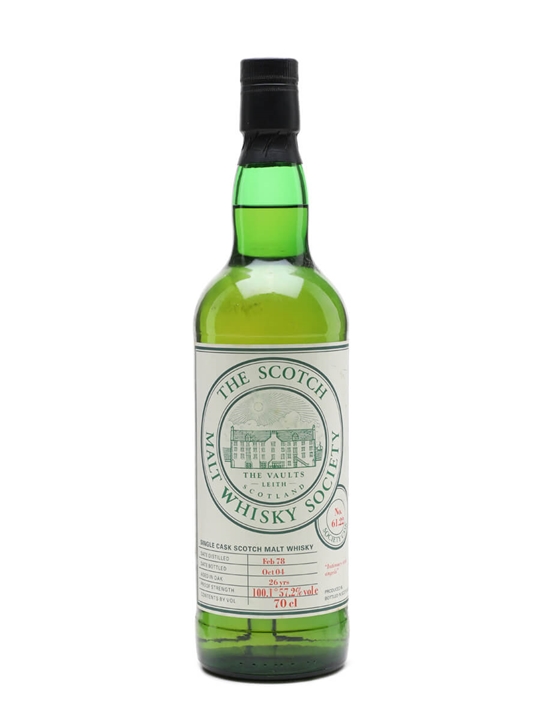

There are bottles you review, and there are bottles that remind you why you fell in love with whisky in the first place. SMWS 61.22 — titled 'Intimacy with Angels' by the Scotch Malt Whisky Society — is firmly in the latter category. Distilled in 1978 and left to mature for twenty-six years, this is a Highland single malt bottled at a commanding 57.2% ABV. The SMWS code 61 points to Brora, though the Society's characteristic discretion leaves that formally unconfirmed. At £3,000, this is not a casual purchase. It is a piece of whisky history, and it demands to be taken seriously.
What to Expect
A 1978 distillation puts this squarely in the era when Brora — if that is indeed the source — was producing spirit under conditions that no longer exist. The distillery closed its doors in 1983, and every remaining cask from that period is a diminishing resource. Twenty-six years in oak at cask strength means the angels have taken their considerable share, concentrating what remains into something dense and layered. At 57.2%, expect weight and authority on the palate. This is not a whisky that whispers.
The SMWS's chosen title, 'Intimacy with Angels,' is more poetic than their usual fare, and it tells you something about the character they found in this cask. Highland malts of this vintage and age tend toward a rich interplay of waxy fruit, old leather, and coastal minerality — though I will not speculate beyond what I found in the glass. What I can say is that the balance between strength and maturity here is remarkably well-judged. Cask-strength bottlings of this age can occasionally tip toward over-oaked astringency, but this one carries its years with genuine composure.
The Verdict
I have given SMWS 61.22 a score of 8.3 out of 10, and I want to be clear about what that represents. This is a very good whisky — in some moments, an exceptional one. The concentration of flavour at natural strength, the sheer depth that a quarter-century of maturation provides, and the historical significance of the distillation year all contribute to a bottle that commands attention. Where it falls just short of the highest marks is in accessibility. At this price point and this strength, it asks a great deal of the drinker, and not every pour revealed the same level of complexity. Some cask-strength veterans will find that variability part of the charm. I found it occasionally uneven, though never less than impressive.
For collectors and serious Highland devotees, this is a bottle worth pursuing if you can find one. The 1978 vintage from this particular distillery represents a style of whisky-making that simply cannot be replicated today, regardless of how faithfully modern operations attempt to honour it. That scarcity is real, not manufactured, and it is reflected honestly in the price.
Best Served
Neat, in a tulip-shaped nosing glass, with patience. Give it a full ten minutes to open after pouring. If the 57.2% proves assertive on first approach — and it likely will — add no more than a few drops of still water at room temperature. This is a whisky that rewards restraint. I would strongly advise against ice or any mixer. You do not spend £3,000 to obscure what two and a half decades of oak have built.