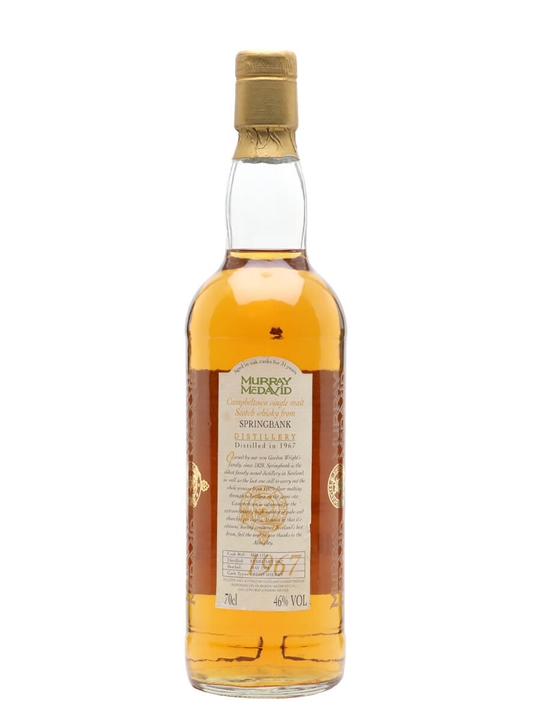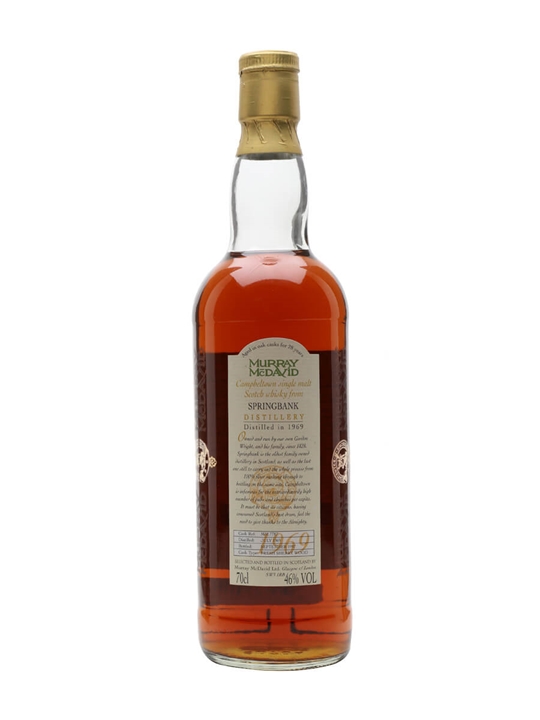
There are places where time moves differently. Campbeltown is one of them. Once home to more than thirty distilleries, this wind-bitten peninsula on Scotland's Kintyre coast now holds just three — and Springbank is the one that never stopped doing things the old way. So when a 1969 vintage surfaces, bottled at 28 years old by the independent hand of Murray McDavid, you sit up. You clear the evening. You pay attention.
This is a whisky distilled in the dying days of the sixties, when Campbeltown was still in its long decline, when the town's remaining distillers were producing spirit more for survival than posterity. That it survived nearly three decades in a sherry cask, emerging at a confident 46% ABV without chill filtration, speaks to the quality of both the spirit and the wood. Murray McDavid, founded by Mark Reynier and Simon Coughlin, built their reputation on exactly this kind of cask — sourced with care, bottled with minimal interference, presented without theatre. The whisky is the statement.
At 28 years old, you're deep into the territory where Campbeltown's defining character — that briny, slightly industrial, oil-lamp-and-harbour quality — has had decades to negotiate with sherry influence. The result, in bottles of this era and provenance, tends toward something extraordinary: coastal weight dressed in dried fruit and aged oak, a spirit that carries both the sea and the cellar in equal measure. This is not a whisky that hides behind its cask. Springbank's distillate is too forthright for that, too full of its own salt-crusted personality.
Tasting Notes
I won't manufacture specifics where precision demands the glass in hand. What I will say is this: a 1969 Springbank from sherry wood, bottled in the late nineties at natural strength, belongs to a category of whisky that barely exists anymore. The combination of old Campbeltown distillate and long sherry maturation produces a style that is dense, coastal, and profoundly layered — the kind of dram where every return to the glass finds something the last sip missed. At 46%, it has the presence to fill a room without the burn that would rush you through it.
The Verdict
At £2,500, this is a bottle that asks serious questions of your wallet. But consider what you're buying: a snapshot of Campbeltown distilling from over half a century ago, matured through nearly three decades of slow transformation, and released by one of the most respected independent bottlers of the modern era. This is not a whisky you drink casually — it's one you return to, one that rewards patience and a quiet room. An 8.7 feels right. It loses nothing for what it is; it simply exists in a space where perfection is a matter of personal mythology, and this bottle is busy writing its own. For collectors and serious drinkers of Campbeltown whisky, it's as close to essential as the word allows.
Best Served
Neat, and only neat. A heavy-based Glencairn or a thin-lipped copita, a few drops of cool spring water if you must — but give this one time and air before you even think about nosing it. Pour it twenty minutes before you plan to drink. Let it wake up. A dram like this deserves a evening with no distractions: a low fire, a worn armchair, and the sound of rain on the window wouldn't hurt either. Campbeltown whisky has always tasted best when the weather outside reminds you why they built distilleries there in the first place.