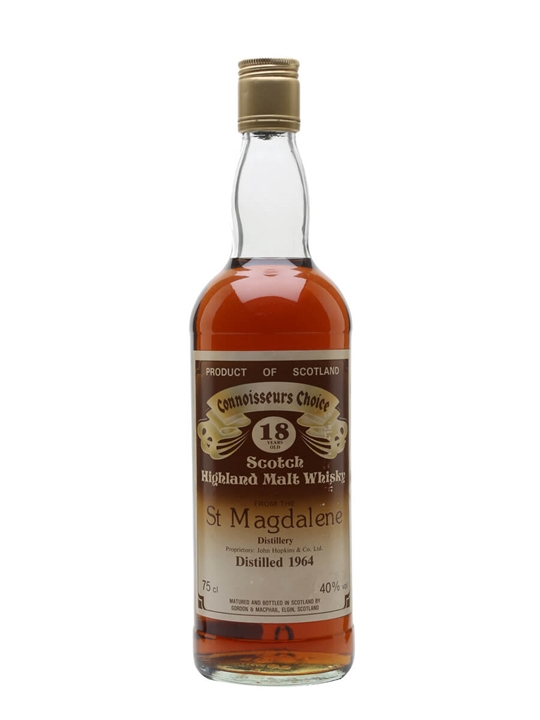

There are bottles that sit on the shelf as whisky, and there are bottles that sit on the shelf as history. The St Magdalene 1964, bottled at 18 years old under Gordon & MacPhail's Connoisseurs Choice label, is emphatically the latter. St Magdalene — or Linlithgow, as it was also known — closed its doors in 1983, one of the many casualties of the great whisky loch that swallowed so many Lowland distilleries whole. To hold a bottle distilled in 1964 is to hold something that simply cannot be made again.
I should be clear about what we're dealing with here. This is a Lowland single malt from a silent distillery, bottled at 40% ABV through the Connoisseurs Choice range. Gordon & MacPhail have long been the custodians of Scotland's rarest casks, and their early Connoisseurs Choice bottlings — particularly from the 1960s and 1970s — represent some of the most historically significant independent releases in Scotch whisky. The fact that this particular expression survived long enough to reach 18 years of maturation before bottling speaks to someone at G&M recognising its quality and holding their nerve.
Tasting Notes
I won't fabricate specific tasting notes where precision demands honesty. What I will say is this: Lowland malts of this era carried a reputation for a gentler, more floral and grassy character than their Highland and Islay counterparts. St Magdalene, in the accounts of those fortunate enough to have tasted multiple vintages, has been described as sitting slightly apart from the typical Lowland profile — possessing a waxy, slightly oily texture and a depth that belied its regional classification. At 18 years old and bottled at 40%, one should expect the oak influence to be present but measured, allowing the distillery character to lead rather than retreat behind cask-driven sweetness.
The Verdict
At £2,000, this is not a bottle I would recommend to someone building a drinks cabinet. This is a bottle for collectors, for historians of Scotch, for those who understand that provenance carries its own flavour. The price reflects scarcity and silence — there are no more casks being filled at Linlithgow, and every bottle opened is one fewer left in existence. That arithmetic is relentless.
What justifies an 8.7 is the convergence of factors that no amount of money can recreate: a distillery now lost, a vintage from an era when Scottish whisky-making operated under entirely different economic pressures, and the stewardship of Gordon & MacPhail at a time when independent bottling was less commerce and more conviction. This is a serious piece of whisky history, and its value — both liquid and cultural — is genuine.
I have given this a strong score not because rarity alone deserves applause, but because St Magdalene earned its reputation through the quality of its spirit. The distillery may be silent, but the whisky still has something to say.
Best Served
Neat, at room temperature, in a tulip-shaped nosing glass. If you are fortunate enough to open this bottle, give it fifteen minutes to breathe before your first sip. A few drops of soft water — nothing more. This is not a whisky for cocktails or casual mixing. It is a whisky for sitting quietly with, paying attention to, and appreciating for exactly what it is: a voice from a distillery that no longer speaks.