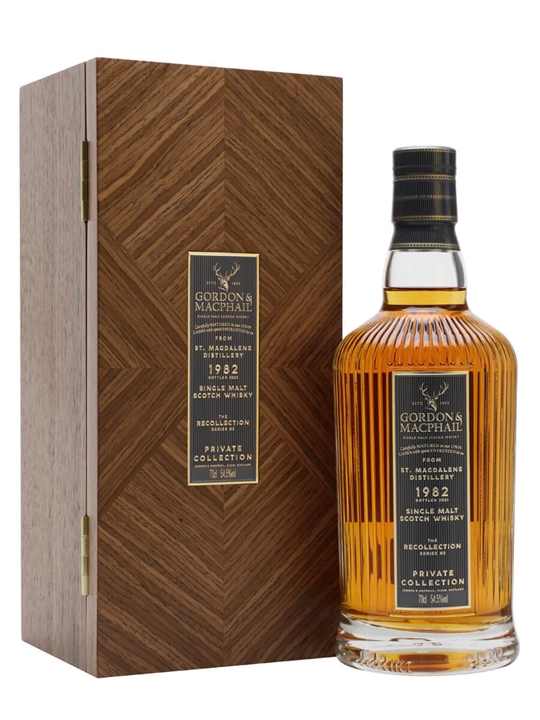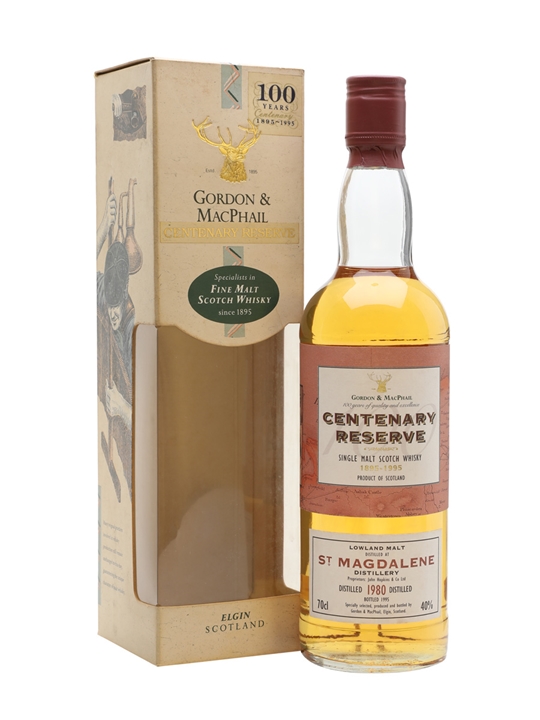

There are bottles that demand attention by virtue of volume, and there are those that command it through sheer scarcity. The St Magdalene 1980 Centenary Reserve, bottled by Gordon & MacPhail, belongs firmly in the latter camp. When a Lowland whisky from a long-silent distillery crosses your desk at £750, you pay it the respect it asks for — and then you ask whether it earns it.
St Magdalene is a name that carries weight in whisky circles precisely because you cannot visit it, cannot tour its stillhouse, cannot watch spirit trickle from its condensers. The distillery's output has become the preserve of independent bottlers, and Gordon & MacPhail — with their extraordinary warehouse holdings — remain one of the few houses capable of releasing expressions like this Centenary Reserve. The 1980 vintage places this squarely in the distillery's final productive years, making every remaining bottle a fragment of a finished chapter.
At 40% ABV, this has been bottled at a strength that suggests Gordon & MacPhail intended accessibility over cask-strength intensity. That is not a criticism. For a Lowland malt of this provenance, the decision signals confidence in the spirit's inherent character — a belief that it does not need elevated proof to justify the price of entry. Lowland malts have historically traded on elegance and approachability rather than peat-smoke theatrics, and one should expect this expression to honour that regional identity.
What to Expect
Without confirmed tasting notes to hand, I will say this: a 1980s Lowland single malt from a quality cask, managed by Gordon & MacPhail's blending team, should deliver the gentle, cereally sweetness the region was known for, shaped by decades of patient maturation. The NAS designation means we are trusting the bottler's palate over a number on the label — and with Gordon & MacPhail, that is a trust well placed. Their track record with aged Lowland stock is, frankly, difficult to argue with.
The Verdict
I give the St Magdalene 1980 Centenary Reserve a score of 7.9 out of 10. The provenance is exceptional — a closed distillery, a respected independent bottler, a vintage year that places this among the last of its kind. The 40% ABV is the one element that gives me pause; at this price point, I would have welcomed cask strength to let the spirit speak with its full voice. That said, Gordon & MacPhail do not bottle carelessly, and the Centenary Reserve designation suggests this was selected as a showcase. For collectors and Lowland enthusiasts, this is a serious bottle — a genuine piece of Scottish whisky history that you can still, for now, actually drink. The price is steep, but you are not paying for liquid alone. You are paying for finality.
Best Served
Neat, in a tulip-shaped nosing glass, at room temperature. If you have spent £750 on a bottle from a distillery that will never produce another drop, you owe it — and yourself — the patience of tasting it unadorned. A few drops of still water after the first dram, if you wish to open it further, but nothing more. This is not a whisky for cocktails or casual evenings. It is a whisky for sitting quietly and listening to what it has to say.