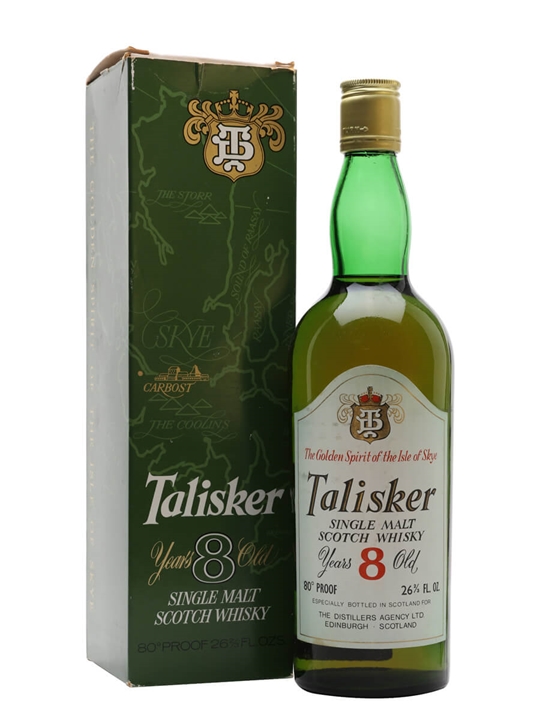

There are bottles that sit on a shelf, and then there are bottles that belong in a glass case. The Talisker 8 Year Old, bottled sometime in the 1970s, is firmly in the latter category — though I'd argue the real tragedy would be never opening it at all. This is a piece of Scotch whisky history, a snapshot of Talisker as it was before the distillery's output became one of the most recognised names on the planet.
What makes this bottling so remarkable is its age — or rather, its youth. Eight years is short for a single malt, and yet Talisker has always been a distillery whose spirit doesn't need decades in oak to announce itself. At 45.8% ABV, this was bottled at a strength that suggests confidence in the liquid. No hiding behind dilution here. This is Talisker as the distillery intended it to be experienced in that era: punchy, unapologetic, and coastal to its core.
The 1970s were a fascinating period for Scotch. Production methods, yeast strains, barley varieties — all differed from what we see today. A bottle from this era isn't just whisky; it's a time capsule. The character of Talisker's spirit would have been shaped by conditions and practices that no longer exist in quite the same form, which is precisely what collectors and serious drinkers are paying for at this price point.
Tasting Notes
I won't pretend to have cracked this bottle open on a whim — at £1,250, every pour is a considered occasion. What I will say is that the style of Talisker at eight years old, particularly from this period, leans into the raw, elemental character of the distillery's Island home. Expect the hallmark maritime intensity that defines the house style, delivered with a directness that older expressions sometimes soften away. The higher-than-standard bottling strength preserves texture and weight in a way that rewards patience in the glass.
The Verdict
An 8/10 feels right for this bottling. It earns its score not through complexity alone but through sheer authenticity and rarity. This is Talisker before global demand reshaped production volumes, before age statements crept upward and marketing departments got involved. It's a genuine artefact. The price reflects that scarcity, and whether the investment is justified depends entirely on what you value in a whisky. If provenance, history, and the chance to taste a bygone era of Scotch production matter to you, this bottle delivers on every count. It is not a casual purchase, but it is a serious whisky for serious collectors.
Best Served
Neat, at room temperature, in a tulip-shaped nosing glass. Give it ten minutes to open after pouring — spirit from this era can be initially reticent before it finds its voice. A few drops of still water may coax out further nuance, but I'd taste it unadorned first. This is not a whisky for cocktails or ice. It deserves your full attention and an unhurried evening.