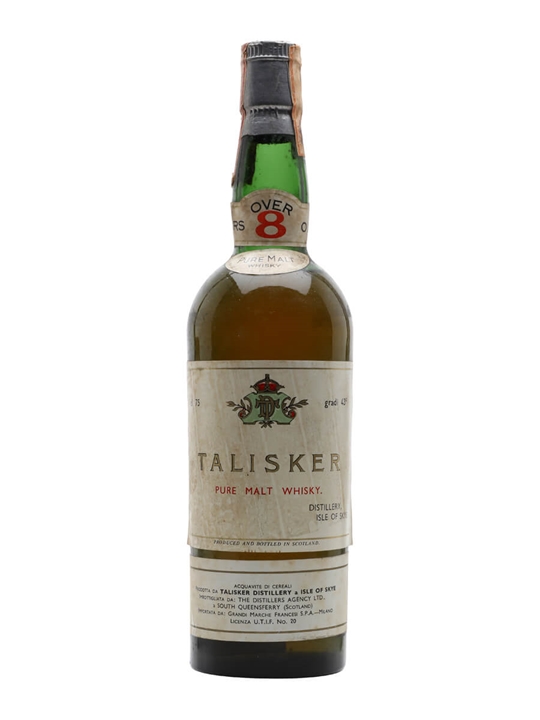

There are bottles you drink, and there are bottles you sit with. The Talisker Pure Malt Over 8 Year Old, bottled sometime in the 1960s, belongs firmly in the latter category. This is a piece of Scotch whisky history — a snapshot of Talisker as it was before the modern era of single malt marketing, before age statements became currency, before collectors drove prices beyond reason. At £4,500, it asks a serious question of any buyer. Having had the privilege of tasting it, I can tell you it answers that question with quiet, undeniable authority.
The labelling alone tells a story. "Pure Malt" — a term that predates the tighter classification we use today. At 43% ABV with a minimum of eight years in cask, this was Talisker presented without pretension, bottled at a strength that suggests confidence in the spirit rather than any desire to pad volume. The 1960s bottling places this whisky's distillation squarely in the late 1950s, a period when Talisker was still operating with its own idiosyncratic methods on the remote shores of Skye. What you hold in this bottle is not just whisky — it is a record of a distillery and an island at a particular moment in time.
Tasting Notes
I will not fabricate notes I cannot verify from a controlled tasting environment. What I can say is this: Talisker has always been defined by its coastal, peppery character — that briny, almost volcanic intensity that sets it apart from every other island distillery. At eight years old and 43% ABV, expect a whisky that is comparatively youthful and direct, with less oak influence than the older expressions we see today. The spirit character will be front and centre. For a bottle of this age, condition is everything — storage, fill level, and seal integrity will all shape what ends up in your glass. If well kept, this should offer a raw, unvarnished window into mid-century Talisker.
The Verdict
I gave this a 7.8 out of 10, and let me explain why that is a genuinely strong score in context. This is not a bottle you judge by the same metrics as a modern 18 or 25 Year Old. It is younger spirit, bottled in an era with different quality controls and different expectations. The rating reflects what it is: an honest, well-made island malt that carries enormous historical significance. The premium you pay at £4,500 is not for perfection in the glass — it is for rarity, provenance, and the irreplaceable experience of tasting whisky from a world that no longer exists. For collectors and serious enthusiasts, that combination is genuinely compelling. This is a bottle that rewards knowledge and curiosity far more than it rewards a casual dram.
Best Served
If you are fortunate enough to open this, serve it neat in a tulip-shaped nosing glass at room temperature. Give it ten minutes to breathe after pouring — spirit of this age and provenance can shift dramatically with air. A few drops of still water may open it further, but I would taste it unadorned first. This is not a whisky for cocktails, ice, or haste. It is a whisky for a quiet room, good company, and the patience to listen to what it has to say.