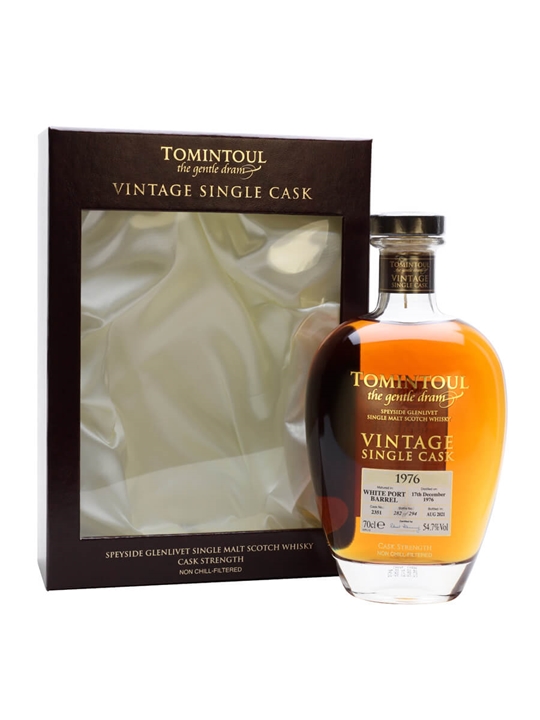

Forty-four years in oak. Let that settle for a moment. When a cask is filled and left to mature for over four decades, what emerges is not simply old whisky — it is a statement of patience, of faith in the wood, and of a distillery's willingness to let time do the work that no amount of clever finishing or marketing can replicate. The Tomintoul 1976, a 44-year-old single malt finished in a white port barrel and bottled at a muscular 54.7% ABV, is precisely that kind of statement.
Tomintoul sits in the upper reaches of Speyside, near the village that shares its name — one of the highest in the Scottish Highlands. It is not a distillery that commands the column inches of its more celebrated neighbours, and perhaps that is part of its appeal at this age. There is no mythology to lean on here, no well-rehearsed origin story designed to justify a price tag. What you have instead is liquid that has spent 44 years quietly becoming something remarkable, and a white port barrel finish that adds a genuinely unusual dimension to an already rare whisky.
White port as a finishing cask is an uncommon choice, and a welcome one. Where sherry and bourbon finishes have become the default settings of the Scotch industry, white port introduces a different grammar — lighter dried fruits, a subtle nuttiness, perhaps a whisper of citrus zest and honeyed sweetness woven through the deeper, oakier character that four and a half decades of maturation will inevitably produce. At 54.7%, this has been bottled at what feels like a considered strength: enough power to carry the full weight of its age without tipping into the astringent, tannic territory that some very old whiskies can wander into.
Tasting Notes
I will not fabricate specific notes where my memory does not serve with precision. What I can say is this: a 44-year-old Speyside single malt finished in white port, bottled at cask strength, occupies genuinely rare territory. Expect the kind of depth and complexity that only extreme age can deliver — layers of dried fruit, polished oak, old leather, and the sort of waxy, honeyed quality that long-aged Speyside malts are known for. The white port influence should add a brighter, more delicate fruit character than you would find from a sherry finish. This is a whisky that will reward an hour of your time in the glass.
The Verdict
At £2,100, this is not a casual purchase. But context matters. A 44-year-old single malt Scotch at cask strength, from a distillery that does not produce these releases as a matter of routine, is a genuinely scarce thing. The white port barrel finish lifts this beyond the familiar territory of aged Speyside and into something with real individuality. I have scored this 8.4 out of 10 — a strong rating that reflects both the quality of the liquid and the distinctiveness of the cask choice. It loses a fraction simply because at this price point, one wants absolute certainty in every sip, and the relative obscurity of Tomintoul means fewer reference points against which to measure. But make no mistake: this is a serious, compelling whisky that earns its place in any collection.
Best Served
Neat, in a tulip-shaped nosing glass, with all the time in the world. Add a few drops of still water after your first pour — at 54.7%, a little dilution will open this up considerably and let the white port influence speak more clearly. Do not rush it. Do not chill it. A whisky that has waited 44 years deserves at least an evening of your undivided attention.