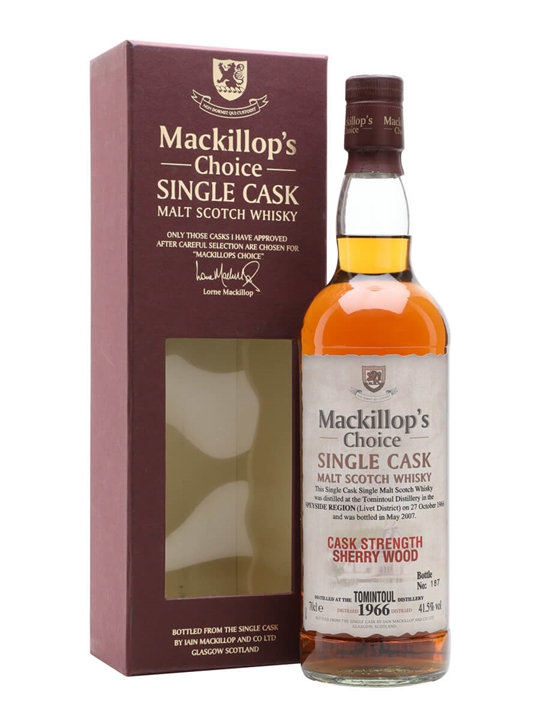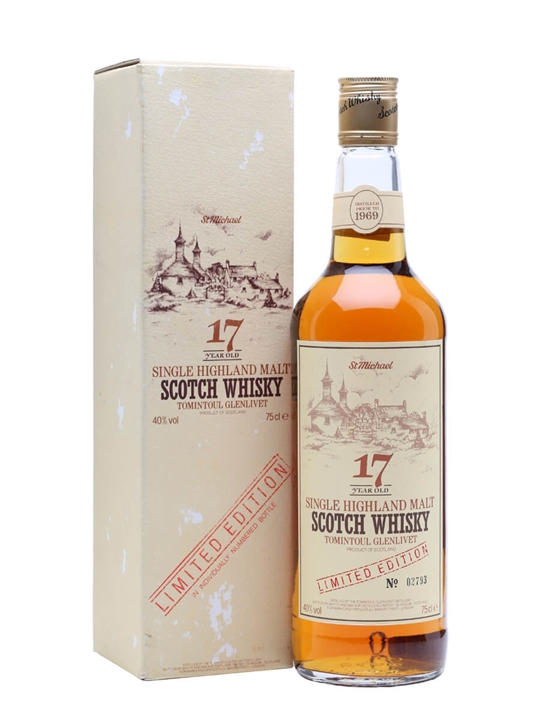

There are bottles that sit on a shelf and tell you everything about a specific moment in Scotch whisky history. The Tomintoul-Glenlivet 17 Year Old, distilled prior to 1969 and bottled sometime in the 1980s, is one of those bottles. It belongs to an era when Speyside distilleries were still operating under older production rhythms — before the widespread modernisations of the 1970s reshaped much of the region. To hold a bottle like this is to hold a direct link to a style of whisky-making that simply no longer exists in the same form.
The hyphenated Glenlivet suffix is itself a marker of the period. Before trademark protections tightened, numerous Speyside distilleries appended '-Glenlivet' to their names as a quality signal, borrowing the prestige of the region's most famous glen. Seeing it on the label here immediately dates this bottling and places it within a particular tradition of independent or proprietary releases that circulated through the 1980s whisky market — a market that, it should be said, valued these malts far less than collectors do today.
What to Expect
At 40% ABV, this sits at the standard strength of its era. Many bottlings from the late 1960s and 1970s distillation period were reduced to 40% or 43% as a matter of course. What that typically preserves in a Speyside malt of this age is a softness and roundness that rewards patience. Seventeen years in oak — likely refill casks, given the conventions of the time — would have allowed the spirit to develop a gentle, honeyed complexity without the aggressive wood influence that can dominate longer-aged modern bottlings.
Speyside malts from this pre-1969 window are generally prized for their orchard fruit character, a certain waxy quality, and a clean, malty backbone that speaks to the barley varieties and floor maltings still common in that period. I would expect this Tomintoul-Glenlivet to follow that template: approachable, elegant, and quietly rewarding rather than loud or showy. It is a whisky that asks you to pay attention.
The Verdict
At £500, this is not a casual purchase. But for what it represents — a genuine pre-1969 Speyside malt with nearly two decades of maturation, bottled in an era before the collector market inflated prices beyond reason — I consider it fairly positioned against comparable old bottlings that now routinely command four figures. The 8.2 I am giving it reflects both its historical significance and the quality profile one can reasonably expect from a Speyside malt of this provenance and age. It is not the most powerful whisky you will ever drink. It is, however, the kind of whisky that reminds you why Speyside earned its reputation in the first place. A piece of liquid history, and one worth seeking out if old-style Scotch is what moves you.
Best Served
Neat, at room temperature, in a tulip-shaped nosing glass. If you have managed to acquire a bottle of this age and rarity, let it breathe for ten minutes after pouring. A few drops of still water may open it further, but at 40% ABV it should not require much coaxing. This is a whisky for a quiet evening and undivided attention — not for mixing, not for rushing.