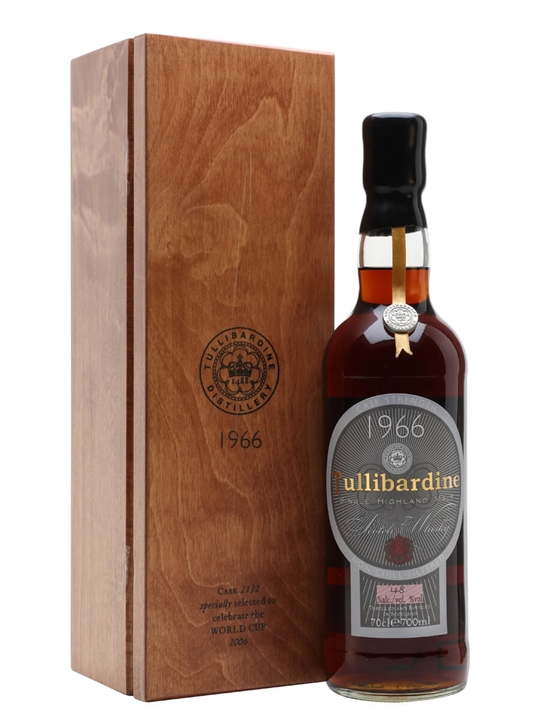

There are bottles that sit on a shelf and quietly demand your attention — not through flash or fanfare, but through sheer provenance. The Tullibardine 1966 / 2006 World Cup / Sherry Cask #2132 is precisely that sort of whisky. Distilled in 1966 and bottled forty years later to mark the 2006 World Cup, this is a single cask Highland malt that carries four decades of patient maturation in a single sherry butt. At 48% ABV, it has been bottled at a strength that suggests careful consideration rather than cask-strength bravado — enough weight to deliver complexity, enough restraint to remain approachable.
Tullibardine has long occupied an unusual position among Highland distilleries. It sits in the southern Highlands at Blackford, drawing its water from the Danny Burn, and has historically produced a lighter, more delicate spirit than many of its northern neighbours. That lighter new-make character is precisely what makes extended sherry cask maturation so interesting here. Forty years in a sherry butt — cask #2132 — will have allowed the wood to do enormous work on that spirit, and a whisky of this age from a relatively gentle distillate should offer a profile where the cask influence and the original character have had time to reach a genuine equilibrium rather than one simply overwhelming the other.
At £2,250, this is unquestionably a collector's bottle as much as a drinker's one. But that price reflects a simple reality: there are vanishingly few single cask whiskies from 1966 still in existence. The World Cup commemorative bottling adds a layer of occasion to an already rare release, and single cask bottlings of this era carry an inherent individuality that no vatted release can replicate. Each bottle is, by definition, unrepeatable.
What to Expect
A forty-year-old Highland malt from a sherry cask at this strength should deliver considerable depth. Expect the richness and dried fruit character that long sherry maturation brings — think stewed plums, Christmas cake, old leather — layered over what remains of that original Tullibardine lightness. Whiskies of this age often develop a remarkable fragility alongside their complexity; the oak will have contributed structure and spice, but four decades also brings a polished, almost silken quality to the texture. The 48% bottling strength should preserve mouthfeel without any harshness.
The Verdict
I have a great deal of time for this whisky. It represents something increasingly rare in our industry — genuine patience. Not a marketing exercise in age statements, but an actual commitment to letting a cask reach its moment. The fact that Tullibardine chose to bottle this at 48% rather than at full cask strength tells me someone was paying attention to what the liquid needed. At 8 out of 10, this is a whisky I rate highly both for what it is and for what it represents. It is not flawless — no whisky is, and at this age the oak will inevitably have taken a firm hand — but it is genuinely special. For the collector who intends to open it, this is a remarkable piece of Highland history in a glass.
Best Served
Neat, absolutely. Pour it and leave it for ten minutes. A whisky that has waited forty years deserves your patience in return. If you feel it needs opening up after the first few sips, add no more than a few drops of still water — but taste it without first. At 48%, it should not need much encouragement to speak.