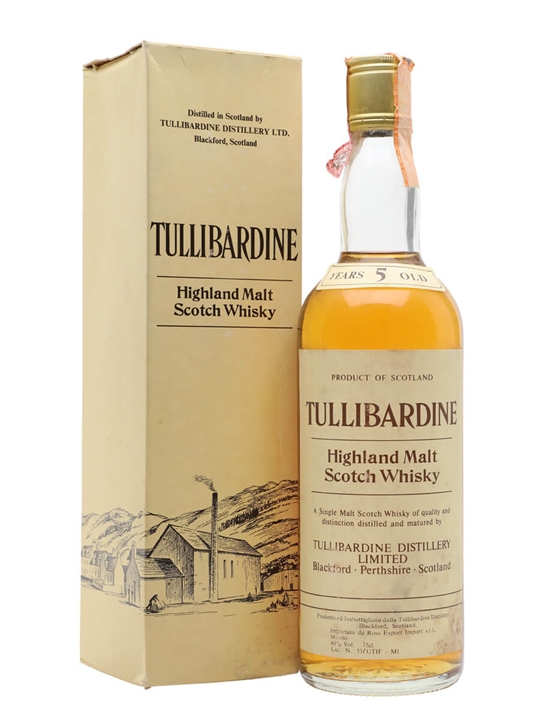

There are bottles that tell you something about where whisky has been, and this is one of them. The Tullibardine 5 Year Old, bottled sometime in the 1980s, is a snapshot of a different era in Scotch — one where young Highland malts were bottled without apology, sold at honest prices, and drunk without ceremony. Finding one intact today, four decades on, is another matter entirely.
Tullibardine sits in the southern Highlands, just off the A9 at Blackford, and has always occupied a curious position in the Scottish whisky landscape. Never a headline distillery, never a cult favourite, but a producer whose spirit — light, clean, malty — has quietly found its way into blends and the occasional single malt release for decades. A five-year-old expression from this era would have been bottled at the standard 40% ABV, likely from refill casks, and represents the distillery's new-make character with relatively little oak influence. That's not a criticism. At five years, you're tasting the distillery, not the wood programme.
What to Expect
With a whisky of this age and provenance, you should expect a spirit that leans into the lighter, grassier side of Highland malt. Tullibardine's house style has long favoured a clean, cereal-forward profile — think fresh barley, a touch of orchard fruit, and that particular honeyed sweetness that well-made Highland malt delivers before heavy cask influence takes over. At 40%, this won't challenge you. It's approachable, straightforward, and entirely honest about what it is. The decades in glass will have softened things further, rounding any rough edges the youth might have originally carried.
The Verdict
I'll be direct: you are not buying this bottle for the liquid alone. A young Tullibardine, however well made, is not competing with the sherried blockbusters or the peated heavyweights that dominate today's market. What you are buying is a piece of whisky history — a 1980s bottling from a distillery that has been mothballed, revived, sold, and reinvented in the years since this bottle was filled. At £175, the premium reflects rarity and age-of-bottle rather than age-of-spirit, and I think that's a fair exchange for the right collector.
As a drinking experience, it delivers exactly what a young Highland single malt should: clean, malty, uncomplicated. There is genuine pleasure in tasting whisky from an era before cask finishing, NAS releases, and limited-edition marketing took hold. This is Scotch as it was — no more, no less. I've scored it 7.7 out of 10. It earns that mark not through complexity, but through authenticity and the simple fact that it does what it sets out to do with quiet competence. The historical interest pushes it further than the liquid alone might warrant, and I think that's entirely legitimate when assessing a bottle like this.
Best Served
Neat, at room temperature, in a tulip glass. If you're opening a bottle with four decades of history behind it, give it the respect of drinking it as it was intended. A few drops of water won't hurt — it may even open up some of the softer cereal notes — but ice would be a disservice. This is a whisky for sitting with, not mixing.