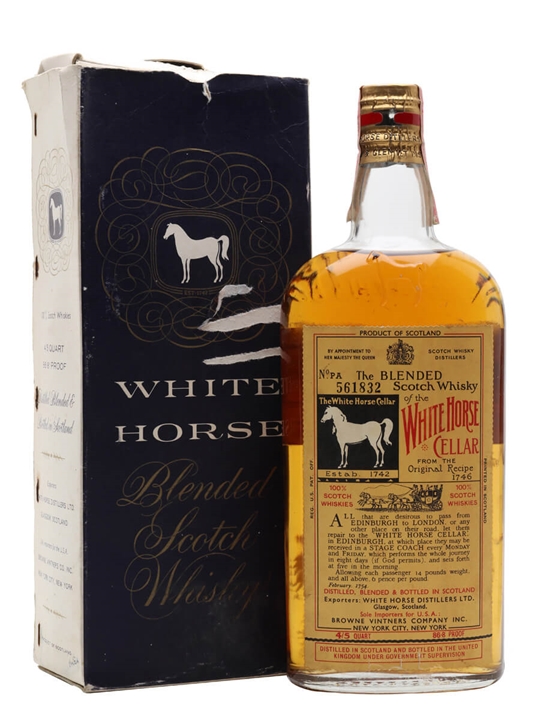

There's a particular thrill in holding a bottle that predates your own existence. This White Horse, bottled sometime in the 1950s and sealed with the distinctive spring cap closure that collectors use to date these things, represents a snapshot of blended Scotch from an era when the category operated under entirely different rules. Different grain stocks, different malt availability, different blending philosophy. At £1,000, you're not buying whisky so much as buying a time machine — and as someone who spent years inside the corporate machinery that now owns this brand, I can tell you the liquid inside this bottle was made in a world that no longer exists.
White Horse has always been one of the more characterful blends. Even today's expression punches above its weight class, but in the 1950s, the blending house had access to malt components that were, frankly, built differently. Lagavulin has long been the backbone malt of White Horse — that much is well documented — and the peat levels, fermentation times, and cask management of mid-century Islay production were a far cry from the standardised processes we see now. The 43% ABV is also telling: this was bottled at a strength that suggests confidence in the liquid, at a time when many blends were already drifting toward 40%.
What to Expect
Without sitting down to a formal tasting, I'll say this: vintage blended Scotch from this period consistently surprises people who assume blends can't compete with single malts. The grain whisky of the 1950s was typically distilled in Coffey stills operating at lower proofs than modern column stills, which means more flavour carried through into the final spirit. Combined with what would have been predominantly refill sherry casks — first-fill bourbon influence hadn't yet colonised the Scottish industry — you're looking at a blend with density and texture that modern equivalents simply cannot replicate. The spring cap closure, while not airtight in the way a screw cap is, has generally proven reliable for preservation over decades, assuming proper storage.
The Verdict
I'm giving this a 7.7 out of 10, which might seem restrained for a bottle with this much history. Here's my reasoning: the whisky itself is almost certainly excellent, but the £1,000 price tag places it firmly in the collector's market, and at that level I have to weigh the experience against the investment. You're paying a significant premium for provenance and scarcity. The condition of any bottle this age is also a variable — fill level, storage history, and the integrity of that spring cap all matter enormously. If you find one in good condition with a high fill level, this is genuinely worth the money as both a drinking experience and a piece of Scotch whisky history. It's a window into what blending used to mean when the art was at its peak and the available components were extraordinary. But buy it to drink it. Bottles aren't museums.
Best Served
Neat, at room temperature, in a tulip glass. Give it twenty minutes after pouring — spirit this old needs air to open up, and rushing it would be a waste of both the whisky and your money. A few drops of water if the ABV feels firm, but I'd start without. This is an occasion pour: clear the evening, turn off the phone, and pay attention. You won't get a second chance at this one.